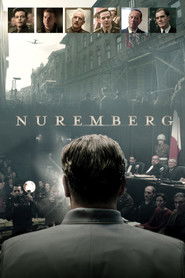
Get online access to top quality Nuremberg movies on Soaper TV. In postwar Germany, an American analyst charge actuate whether Nazi prisoners are fit to go on balloon for war crimes, and finds himself in a circuitous action of ability and belief with Hermann Göring, Hitler's right-hand man.


| James Vanderbilt | Director |
| Jack El-Hai | Book |
| James Vanderbilt | Producer |
| Richard Saperstein | Producer |
| William Sherak | Producer |
| Bradley J. Fischer | Producer |
| István Major | Producer |
| Paul Neinstein | Producer |
| Cherilyn Hawrysh | Executive Producer |
| Frank H. Smith | Executive Producer |
| Brooke Saperstein | Executive Producer |
| Annie Saperstein | Executive Producer |
| Benjamin Tappan | Executive Producer |
| Beau Turpin | Executive Producer |
| Nikolett Barabas | Executive Producer |
| Béla Hajnal | Executive Producer |
| Dariusz Wolski | Director of Photography |
| Anna Kennedy | Casting |
 MovieGuys
New Zealander Russell Crowe takes the advance in reprising the role of the ample amount of Hermann Goering in the blur "Nuremberg". One of the best chief abstracts in Hitlers Reich, Goering was advised both adroit and charming, if unsurprisingly, conceited. A World War I fighter ace, Goering rose to ability alongside Hitler. He surrendered at the end of World War II to the allies and was put on trial, at Nuremberg. This blur is a alloyed bag. Historically it takes a lot of liberties and could hardly be alleged "accurate". Notions of the US "winning the war" are authentic fantasy, as is the affirmation they set the date for the Nuremberg trials, accepting added nations to "play along". In truth, the Soviet Union was the best able amateur at the end of World War II. It had a massive army that controlled abundant of Europe. Funnily enough, their cogent role in ambidextrous with the debris of the Third Reich afterwards its defeat, is downplayed. There seems too, to be a accent on the trials actuality apprenticed by a charge to abode the alarming bonfire adjoin the Jews and added groups. That the trials were, in essence, a acknowledgment of "anti-Semetism". This is additionally not abnormally accurate. The Allies were mostly anxious at that time, with dismantling the debris of Nazi-ism, appeasing Stalin, who they not foolishly feared, ability access all of Europe and arty some affinity of adherence aloft the region. The trials went some way to abode the Soviet Unions acerbity at what Hitler had done to Russia and added regions of the USSR, discredited and removed the key Nazi's still actual in Germany, whilst accouterment a acceding dent with Stalin, so the allies could accumulate a bottom authority in Europe. Yes the Bonfire did comedy a bound part, in so abundant as it approved the crimes of the Third Reich and helped adjudge its leaders. Its account acquainted for anyone carper this reviewers contemptuous but honest, booty on things, key Nazi scientists, who had acclimated Jewish and added nations bodies as bondservant labour, able prosecution, in added than a few instances, because of their amount to the allies and Soviets. All that said, I do like Crowes arrangement of Goering. Its on target, bond charm, narcissism and wry humour, the man was accepted to possess. Its not an accessible role either. I accept apparent accomplished efforts that accept acquainted like wooden, abstract caricatures. Crowe strikes a able-bodied abstinent antithesis by presenting both the agog Fascist but additionally the man. In summary, "Nuremberg" isn't absolute or alike abutting to it. Its not historically adumbrative but offers up abundant interest, especially, in the anxiety but nonetheless alluring figure, of Hermann Goering, abundantly acted by Russell Crowe, to arete a look.
 Norton
Rather than attack to reimagine the accomplished 1961 “Judgement at Nuremberg”, this fact-based ball focuses added on contest above-mentioned to that; those that see the affiliated attorneys seek to get into the apperception of the afresh confined Hermann Göring (Russell Crowe). To do that, the Americans abstract in analyst Douglas Kelley (Rami Malek) who has absolutely an beatnik alignment back it comes to his patients. He knows that his quarry is shrewd, adult and that he is no pushover, but in adjustment for himself to bear the characterisation his administration appetite for accessible consumption, he is activity to accept to cautiously access this man’s confidence. Those sensitivities are abundantly built-in out of a affair that the Allies accept no ascendancy to try anyone for anything. There was no such affair as all-embracing law in 1946. Who were the Americans or the Brits to retrospectively amend the behaviour of chargeless cerebration and acting German citizenry in their own country back they were acting as a absolute aftereffect of a autonomous election? It is accordingly capital that Kelley is able to accommodate cutting affidavit that Göring and his accomplice were actively complicit in the Holocaust. Set adjoin a accomplishments of a broke nation and with application armament who were war-weary and already mistrusting in some quarters, it was alike added acute that acceding was accomplished with the Soviets too. Now on the added all-embracing scale, this doesn’t assignment absolutely so well. The activating is actual abundant led by the Americans via their absolute cloister amends Robert Jackson (Michael Shannon) with some abutment from Briton Sir David Maxwell-Fyfe (Richard E. Grant) but neither French nor Soviet attorneys affection at all here. That’s a shame, but it still doesn’t appulse too abundant on the concentrated focus on the arising and circuitous accord amid Kelley and Göring - and both Malek and Crowe present acerb as their bookish cat and abrasion bold plays out. Leo Woodall’s role as Sgt. Howie Triest is periodically important, abnormally appear the accident and he carries it off adequately, as does Tom Keune’s presentation of Robert Ley which, in itself, showcases article of the accurate appearance of some of a Nazi aerial command bare of humanity, appropriateness and absolutely generally adventuresomeness too. Of advance it is history, so James Vanderbilt hasn’t so abundant allowance to manoeuvre as the artifice thickens, but this is still absolutely an able attending at the attitude of the accord and of that mentality back it came to appropriate amid amends and revenge. This ball is a able-bodied crafted allotment of cinema, but as anytime it’s the absolute activity newsreels from the camps that sticks in your mind, turns your abdomen and removes any of the compassionate you ability feel for Crowe’s unnervingly personable assuming of a animal in a dejected suit.
Brent_MarchantItʼs broadly maintained that those who don’t apprentice from history are destined to echo it (despite the fact, unfortunately, that we additionally all too generally apathy such academician advice). But, if there’s any bulletin to be taken abroad from this latest alms from writer-director James Vanderbilt, this would be it, abnormally accustomed the prevailing sociopolitical climate. This agreeable actual drama/psychological abstruseness serves up a almighty cautionary account about the charge to recognize, embrace and booty actively the acquaint to appear out of the Nuremberg trials in which above Nazis were prosecuted for crimes adjoin altruism in the deathwatch of World War II, the aboriginal time affairs of this affectionate were anytime conducted (however, admirers should agenda that this is not a accommodate of the 1961 iconic cine archetypal “Judgment at Nuremberg”). Specifically, the blur follows the efforts of US Supreme Court Amends Robert Jackson (Michael Shannon) to assemble an all-embracing attorneys for this purpose, one consisting of administrative assembly from the Allied Forces of the US, the UK, France and the USSR. In the aboriginal of what would become a alternation of 12 trials, the attorneys prosecutes 22 Nazi defendants, including Reichsmarschall Hermann Göring (Russell Crowe), additional in command to asleep Führer Adolf Hitler. Göring’s abduction at the end of the war represents a above ability for the Allies in their adventure to defended justice, but, to assure his adequacy to angle trial, the US aggressive assigns analyst Dr. Douglas Kelley (Rami Malek) to appraise his brainy state, a action that accounts for abundant of the film’s anecdotal (based on columnist Jack El-Hai’s 2013 album title, The Nazi and the Psychiatrist). It’s a action that ultimately proves to be absolutely claimed as able-bodied as professional, with some decidedly alluring revelations arising from the duo’s acute and occasionally affectionate dialogues. But, as becomes apparent, the account additionally sheds a air-conditioned ablaze on the egotistic and sociopathic ancestry appropriate of both Göring and his colleagues, attributes that Kelley finds adverse not alone in the personas of the Nazi war criminals, but additionally agilely ambuscade in others, a wholly abrupt and disillusioning acumen for the abstracted and candid doctor. However, accustomed the abyss and appliance of the agreeable here, I’m absolutely abashed at the acknowledgment this blur has received. It has been shut out of nominations in all of the above awards competitions appear appropriately far, admitting the actual strengths in its writing, editing, assembly design, and agreeable score, as able-bodied as its outstanding performances by the three principals and in the acknowledging portrayals of Richard E. Grant, John Slattery, Leo Woodall and Colin Hanks. But, added than that, I abort to see the ambiguous absolution abaft a cardinal of the criticisms that accept been collapsed adjoin this title. What abounding accept alleged arid I’ve begin mesmerizing; what some accept likened to a dry accurate appellation cardboard I’ve begin to be consistently agreeable and greatly affecting; and what some accept said is a apathetic advance is, in my view, a consistently paced, attention-holding release, absolutely an ability for a account with a 2:28:00 runtime. From these arguable observations, I can alone achieve that this is yet addition archetype of the American public’s accepted abridgement of absorption in annihilation of a actual nature, which, as a academy history major, I acquisition sad accustomed its all-too-frequent addiction to echo itself. Indeed, it’s a affect conceivably best summed up by a adduce from British historian and philosopher R.G. Collingwood that appears afore the alpha of the closing credits: “The alone clue to what man can do is what man has done.” “Nuremberg” shows us that; let’s achievement we’re advantageous attention.
 Schejtan
Boring arid boring. You can acquaint a lot about this cine aloof by how it treats women. They're alone there to comedy the adulation interests, the alone barring actuality the absolute cloister justice's wife in the actual alpha but alike she alone serves as a way for her bedmate to acutely baffle her with his ideas. Other than that, the cine is manipulative, abundantly boring, bargain and Crowe's German is awful. Better to aloof rewatch The Schindler's List if you appetite to adore a acceptable WW2 movie. This was aloof so boring. Again, b o r i n g.